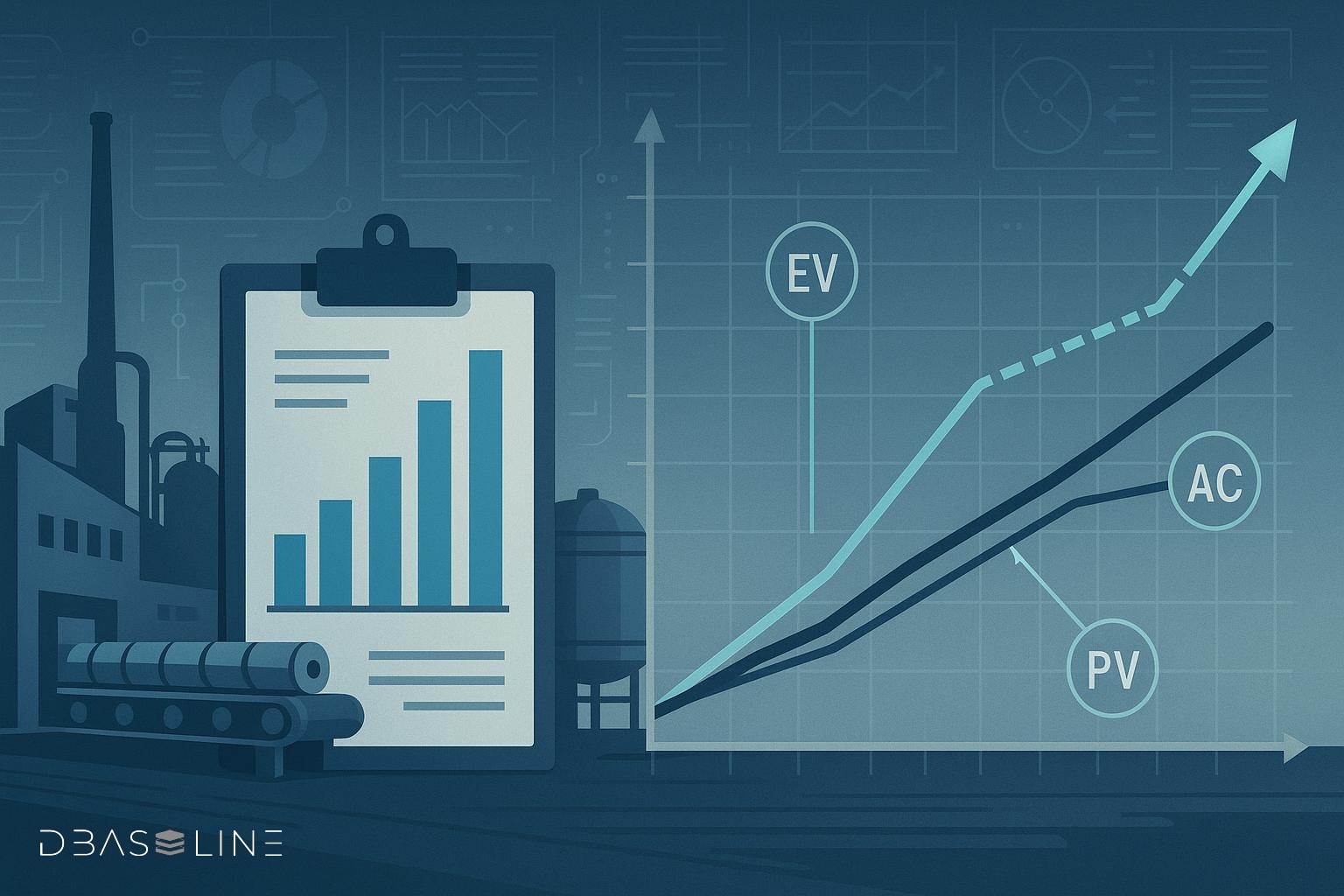
Effective management of industrial projects requires robust tools that enable monitoring and controlling performance in terms of cost and schedule. Earned Value Management (EVM) stands out as a consolidated methodology that integrates scope, time, and cost, providing a comprehensive view of project progress. This article explores the application of EVM in industrial projects, presenting recent case studies and lessons learned that can enhance project planning and control.
Fundamentals of Earned Value Management (EVM)
EVM is a project management technique that combines scope, schedule, and cost measures to assess project performance and progress. The main EVM metrics include:
- Planned Value (PV): The value of the work planned to be completed at a given time.
- Earned Value (EV): The value of the work actually completed to date.
- Actual Cost (AC): The actual cost incurred for the work performed.
From these metrics, indicators such as the Cost Performance Index (CPI) and the Schedule Performance Index (SPI) are derived, providing insights into the project's efficiency relative to budget and schedule.
Case Study: Application of EVM in the Mexican Automotive Industry
A study conducted in 2024 analyzed the implementation of EVM in an intralogistics improvement project at an automotive sector factory in Aguascalientes, Mexico. The project, completed in February 2024, aimed to optimize internal logistics processes to increase operational efficiency.
The application of EVM allowed:
- Monitoring the physical progress of the project relative to the plan.
- Identifying cost and schedule deviations in a timely manner.
- Implementing corrective actions to realign the project with established objectives.
The results demonstrated that the use of EVM provided a clear view of project performance, facilitating informed decision-making and continuous process improvement. Source
Integration of EVM with the Last Planner System (LPS)
Although EVM is widely used, it has limitations, such as the premature release of work and the lack of a process perspective to facilitate improvements. To overcome these limitations, researchers have proposed integrating EVM with the Last Planner System (LPS), originating from Lean philosophy.
LPS focuses on collaborative planning and reliable task execution, while EVM provides quantitative performance metrics. The combination of these approaches, termed Lean Project Planning (LPP), was implemented in a Norwegian pressure vessel fabrication company. The results indicated that LPP provided accurate estimates of cost and completion time, even in the face of significant scope variations. Source
Challenges and Lessons Learned in EVM Implementation
The implementation of EVM in industrial projects is not without challenges. A study analyzing 31 projects in a large aerospace company identified that EVM may not be as effective in project manufacturing environments, where variability and complexity are high. Key lessons learned include:
- The need to adapt EVM to the specificities of the manufacturing environment.
- The importance of integrating EVM with other methodologies, such as LPS, to improve effectiveness.
- Active involvement of stakeholders to ensure successful implementation.
These insights highlight the importance of a flexible and integrated approach when applying EVM in industrial projects. Source
Conclusion
Earned Value Management is a valuable tool for planning and controlling industrial projects, offering an integrated view of performance in terms of cost and schedule. Recent case studies demonstrate that, when adapted to the specific needs of the project and integrated with other methodologies, such as the Last Planner System, EVM can significantly enhance project management. The lessons learned underscore the importance of a personalized and collaborative approach to maximize the benefits of EVM.
For companies seeking to implement or enhance the use of EVM in their industrial projects, Dbaseline offers specialized consulting, assisting in the adaptation and integration of methodologies to achieve superior results.