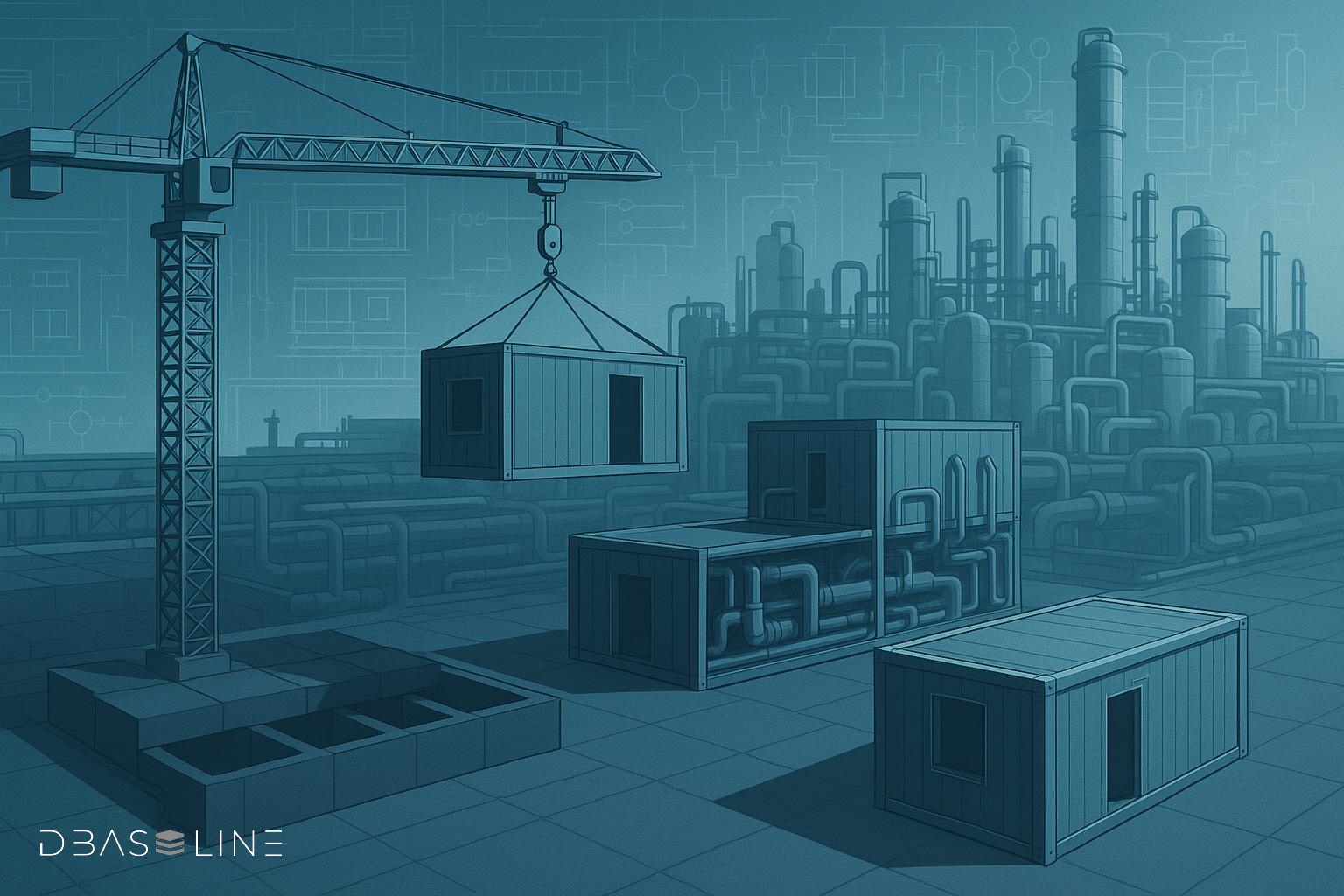
The increasing complexity and scale of Engineering, Procurement, and Construction (EPC) projects have driven the adoption of innovative strategies to optimize timelines, costs, and quality. Among these strategies, modularization and prefabrication emerge as effective solutions to address the inherent challenges of large-scale projects.
Concepts of Modularization and Prefabrication
Modularization refers to dividing a project into smaller modules or units that can be fabricated separately and later integrated at the construction site. Prefabrication involves producing components or systems in a controlled environment, off-site, for subsequent assembly at the final location.
Advantages of Application in EPC Projects
Implementing these approaches in large-scale EPC projects offers several benefits:
- Reduced Timelines: Simultaneous fabrication of modules while preparing the construction site can significantly decrease the overall project duration.
- Quality Control: Controlled manufacturing environments allow for more rigorous quality control, resulting in more reliable final products.
- Cost Efficiency: Mass production of standardized modules can reduce waste and optimize material usage, positively impacting CAPEX.
- Safety: Reducing on-site work time decreases workers' exposure to risks, improving safety indices.
Case Study: Vale's S11D Project
A notable example of the successful application of these strategies is Vale's S11D project, located in Pará, Brazil. Facing operational challenges due to ore particle size, Vale implemented three modular crushing stations supplied by Metso. These stations were designed, manufactured, and delivered in just nine months, reducing the maximum particle size from 450 mm to 150 mm. Installation was completed in 94 days, including commissioning and start-up, demonstrating the effectiveness of modularization in optimizing complex industrial processes. Source
Challenges and Considerations
Despite the benefits, adopting modularization and prefabrication in large-scale EPC projects presents challenges, such as:
- Complex Logistics: Transporting large modules requires detailed planning and may face infrastructure constraints.
- System Integration: Ensuring that prefabricated modules integrate seamlessly on-site requires precise coordination between design and execution teams.
- Initial Investment: Implementing these strategies may demand significant initial investments in manufacturing facilities and personnel training.
Conclusion
Modularization and prefabrication represent promising approaches to enhance efficiency and quality in large-scale EPC projects. Vale's experience in the S11D project illustrates how these strategies can be successfully applied, resulting in tangible benefits. However, it is essential to consider the associated challenges and carefully plan their implementation to maximize positive outcomes.