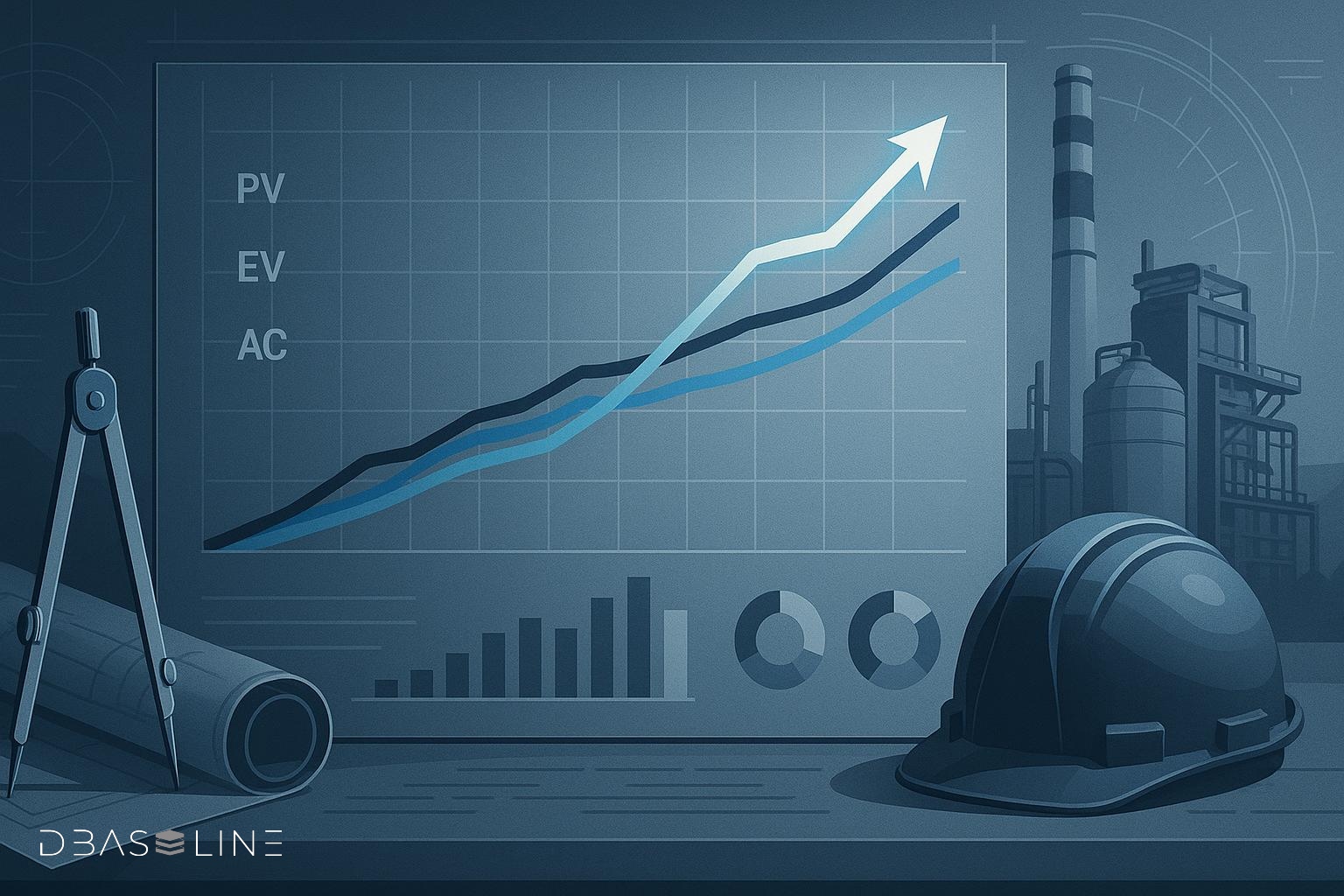
The success of complex industrial projects relies on meticulous planning and rigorous control. Earned Value Management (EVM) emerges as a robust methodology that integrates scope, schedule, and costs, providing a comprehensive view of project performance. This article explores the application of EVM in planning and controlling industrial projects, highlighting real cases and recent data.
Fundamentals of Earned Value Management
EVM is a project management technique that combines scope, schedule, and cost measures to assess project performance and progress. The key metrics of EVM include:
- Planned Value (PV): The value of the work planned to be completed at a specific point in time.
- Earned Value (EV): The value of the work actually completed up to the measurement date.
- Actual Cost (AC): The actual cost incurred for the work performed up to the measurement date.
From these metrics, indices such as the Cost Performance Index (CPI) and the Schedule Performance Index (SPI) are derived, providing insights into the project's cost and time efficiency.
Application of EVM in Industrial Projects
Implementing EVM in industrial projects allows for early identification of deviations, facilitating proactive decision-making. A study conducted at the Amhara Water Works Construction Enterprise in Ethiopia evaluated the performance of 12 projects using EVM. The results indicated that while some projects were completed within budget, others faced inefficiencies and delays due to inadequate resource planning and poor management. The study highlighted the importance of EVM training to improve communication between contracting parties and optimize resource allocation. Source
Integrating EVM with Other Methodologies
Combining EVM with other approaches can further enhance project control. For example, the integration of EVM with the Last Planner System (LPS) was applied in a road construction project in Peru. This joint approach aimed to improve productivity, schedule adherence, and cost control. The study concluded that the collaborative planning practice and objective measurement provided by EVM can recover delayed schedules and maintain financial efficiency. Source
Benefits of EVM in Project Planning and Control
Adopting EVM offers several benefits, including:
- Early Problem Detection: Allows for the identification of cost and schedule deviations at early stages, facilitating timely corrective actions.
- Improved Predictability: Provides more accurate estimates of costs and completion timelines, enhancing decision-making.
- Efficient Communication: Offers a common language for all stakeholders, promoting a clear understanding of project status.
Challenges in Implementing EVM
Despite its benefits, implementing EVM can face challenges such as:
- Organizational Resistance: Changes to established processes may encounter resistance from the team.
- Need for Training: Effective application of EVM requires adequate training of the professionals involved.
- System Integration: Compatibility with existing management systems may require technical adjustments.
Conclusion
Earned Value Management is a powerful tool for planning and controlling industrial projects, offering an integrated view of performance in terms of scope, time, and cost. Effective implementation of EVM, especially when combined with other methodologies, can result in significant improvements in project efficiency and success. For organizations seeking to enhance their project management practices, Dbaseline offers specialized consultancy in the application of EVM and other advanced management techniques.
Frequently Asked Questions
What is Earned Value Management (EVM)?
EVM is a project management methodology that integrates scope, schedule, and costs to objectively assess project performance and progress.
What are the main benefits of EVM?
The main benefits include early problem detection, improved predictability of costs and timelines, and efficient communication among stakeholders.
What challenges may arise in implementing EVM?
Common challenges include organizational resistance, the need for adequate training, and integration with existing management systems.